We check what you are claiming and sharpen the language you claim it in —
not the prose, but the terms, the grammar and the framing a reviewer scores
against.
The research becomes your opportunity records, the eligibility call reads the certifications you confirmed at the start, and the outcomes you gave us turn into the evidence inside a narrative.
Your documents, stories and strategy are reused by everything that writes.
Nothing is gathered twice, and nothing is handed over a wall.
On what gets through
Of 101 basic-science findings published with clear clinical promise, five were licensed for clinical use about twenty years later.
Discovery starts from your profile — your codes, your certifications, your service areas — so the list is short because it is filtered.
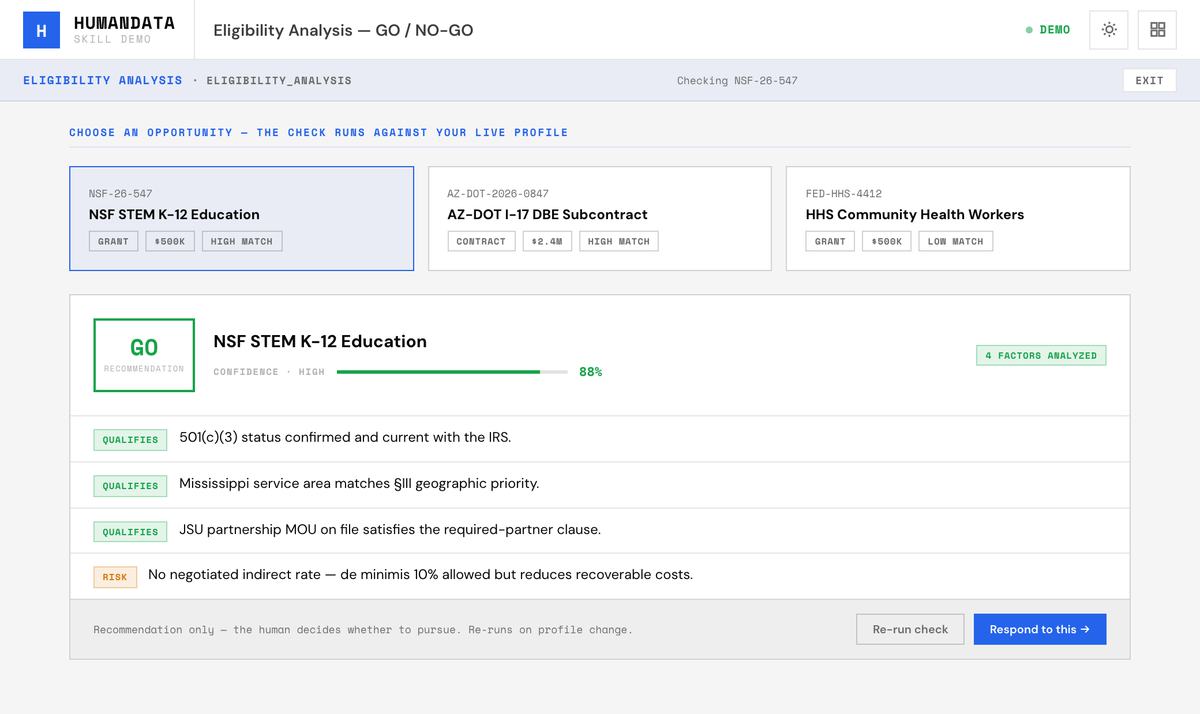
Eligibility Analysis gives a GO or NO-GO with a confidence level, the factors that qualify you, and the factors that put you at risk.
A section schema you confirm before anything is written.
Two clocks
A deal takes a blink. Trust takes years.
Speed governs the operational layer; trust governs the relational layer.
Optimizing one does not require degrading the other — but it does require
building both deliberately.
So the product is fast where the work is mechanical, and it stops for you
wherever a claim is being made in your name.
Fig. 3 — The same transaction, on two clocks9 cleared while trust builds
Fast, where the work is mechanical
Ask in plain language. It searches SAM.gov, Grants.gov and state portals, filtered by your profile.
A forwarded link comes back as a structured record. Two minutes instead of a browser tab you meant to come back to.
Yours to check, where a claim is made
Anything the agent could not verify stays marked in the text for a human to resolve.
On each section you Approve, Revise, Edit or Skip. Nothing leaves the screen on its own.
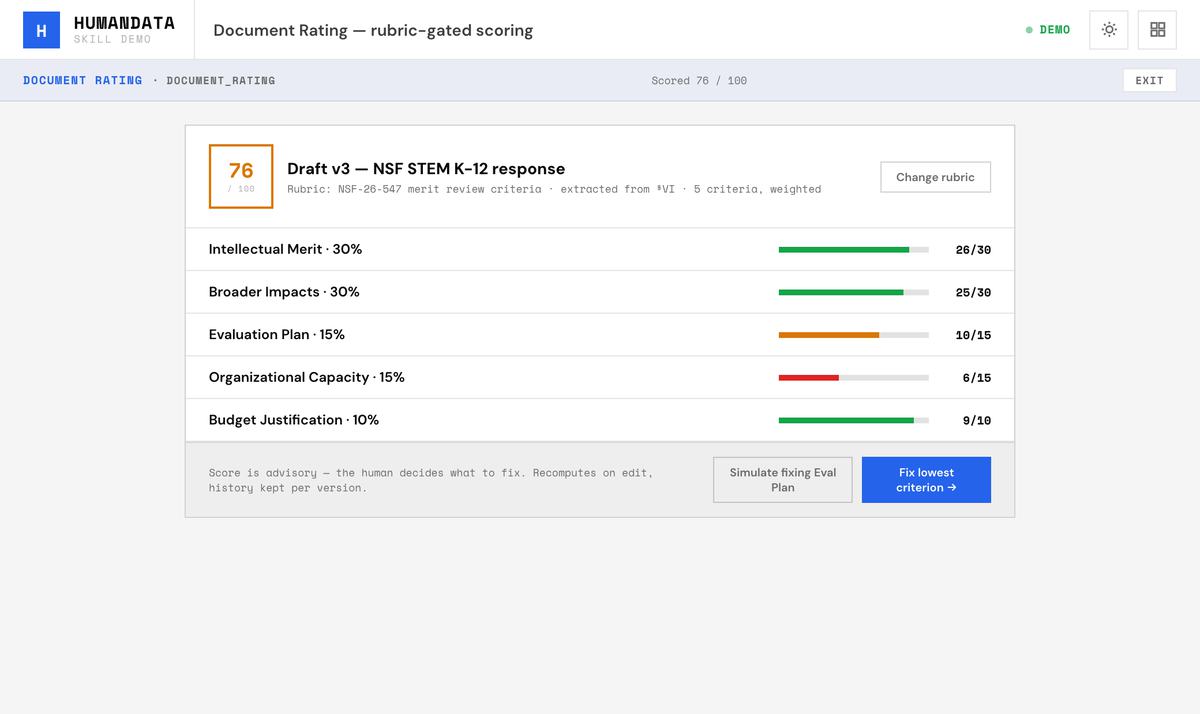
Document Rating scores against a named rubric. It will not invent criteria and hand you a number.
The skills below are not eleven separate tools you log into. They run inside one
workspace, against one profile, and the chat is always on alongside whatever you are
looking at — so starting a skill is a keystroke rather than a navigation.
01
Dashboard
Where things stand.
02
Opportunities
The pipeline, by priority and deadline.
03
Calendar
Deadlines, as dates rather than a list.
04
Knowledge
Your documents, stories and strategy, reused by everything that writes.
05
Profile
The working set everything reads from.
06
Analytics & Billing
What you have spent, and on what.
01 · Foundation
The part nobody sells you, because it is not glamorous.
Most applications fail before they are written. Not on the prose — on a missing
registration, an entity that cannot hold the award, or an outcome nobody wrote down at
the time. This is that work, and everything downstream reads from it.
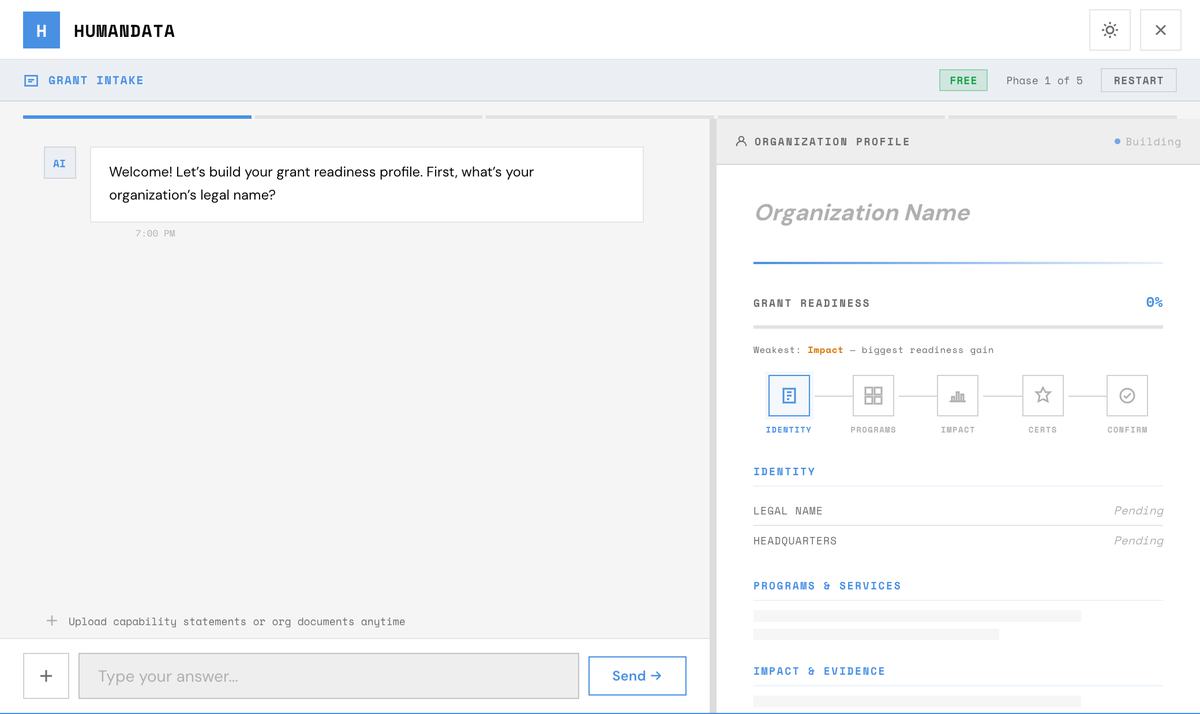
A guided conversation that builds your organisation profile: what you are, what
you deliver, which registrations and certifications you hold, and whether you are
chasing grants, contracts, or both. It ends at that choice, because the rest of
the product branches on it.
Drop in whatever you already have — a capability statement, an old application,
your registrations — and it reads them instead of asking you to type out what is
already written down somewhere.
Called grant_intake inside the product. We call it
readiness here because nobody has ever wanted intake — they want to know whether
they are fundable.
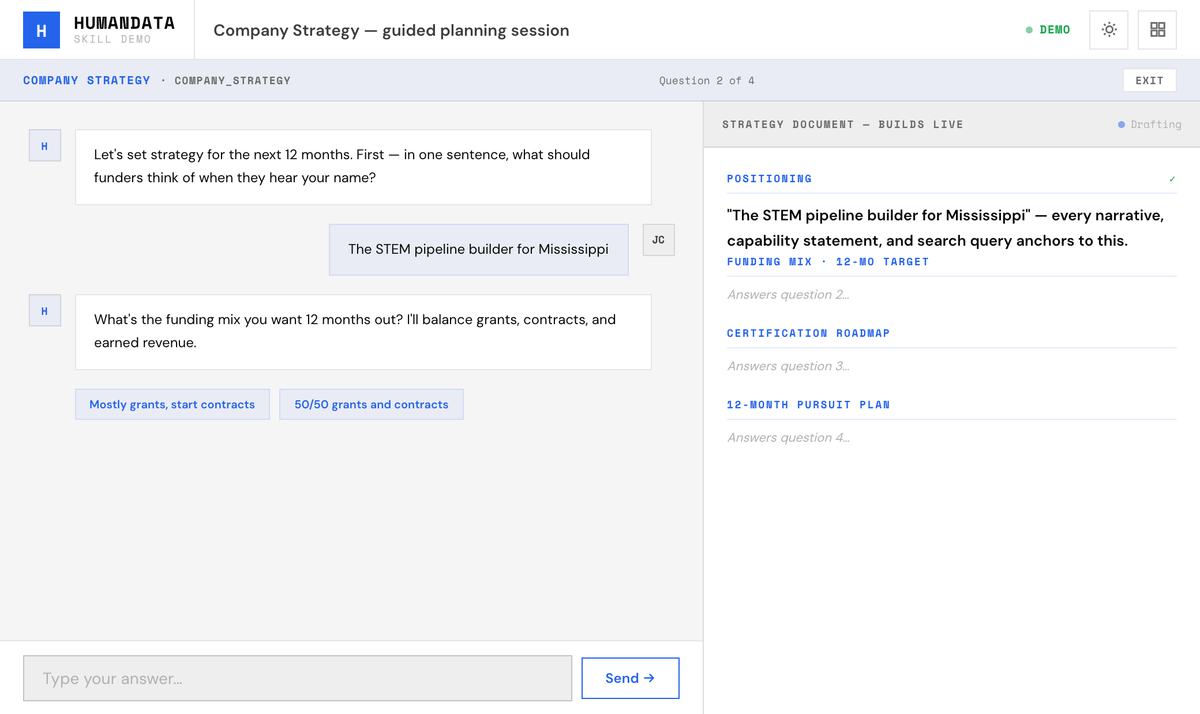
A planning session that produces positioning, your funding mix, a certification
roadmap — 8(a), WOSB, HUBZone and the rest — and a twelve-month pursuit plan.
It writes back to your profile as a strategy document rather than leaving the
conclusions in a chat you will not find again.
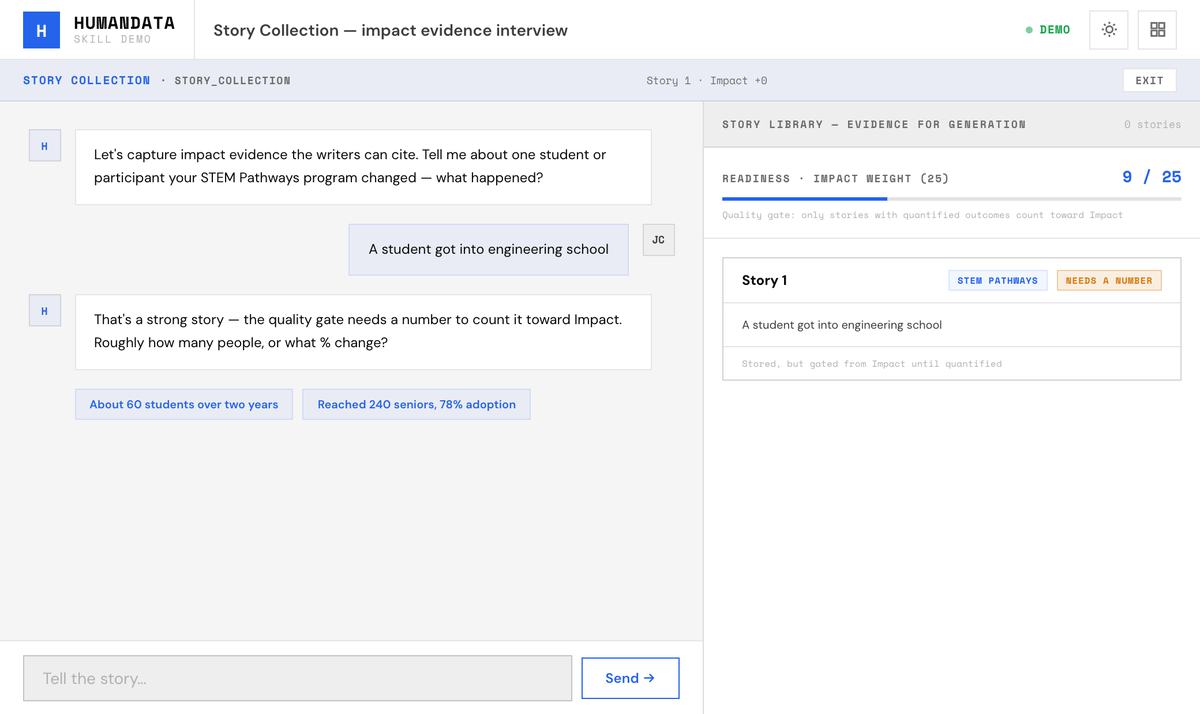
Interviews you for impact stories, testimonials and outcomes you can put a number
on. Each one is tagged by program and handed to the writing step as evidence.
This is the difference between a narrative that asserts and one that
demonstrates. A reviewer scores the second.
02 · Discovery
A short list, because it is filtered — not because the database is.
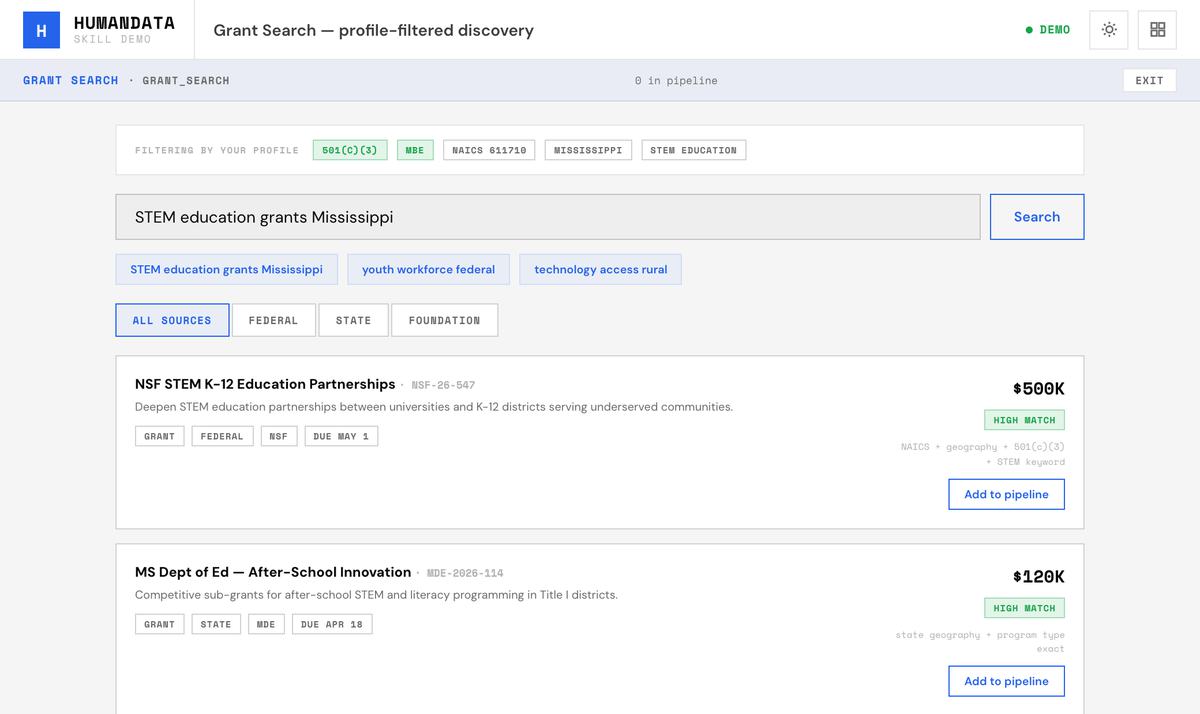
Searching Grants.gov or SAM.gov yourself returns thousands of things you are not
eligible for. Discovery starts from your profile instead: your codes, your
certifications, your service areas.
01
Grant Search
Ask in plain language. It searches SAM.gov, Grants.gov and state portals, filtered
by your profile, and the results land as opportunity cards in your pipeline rather
than as a list you have to re-key.
The same, for the contracting side. The product tracks the full range as distinct
types rather than lumping them together: RFP, RFQ, RFx, CMAS and ITN on the
contracting side, NOFO, LOI, SBIR and STTR on the grant side. SBIR and STTR
sit with the grants because that is how most agencies award them, though the
instrument changes by agency and the record carries whichever it is.
Set-asides are first-class too, so DVBE and SB work is
distinguishable from open competition at a glance instead of being buried in the
text.
03
Add Opportunity
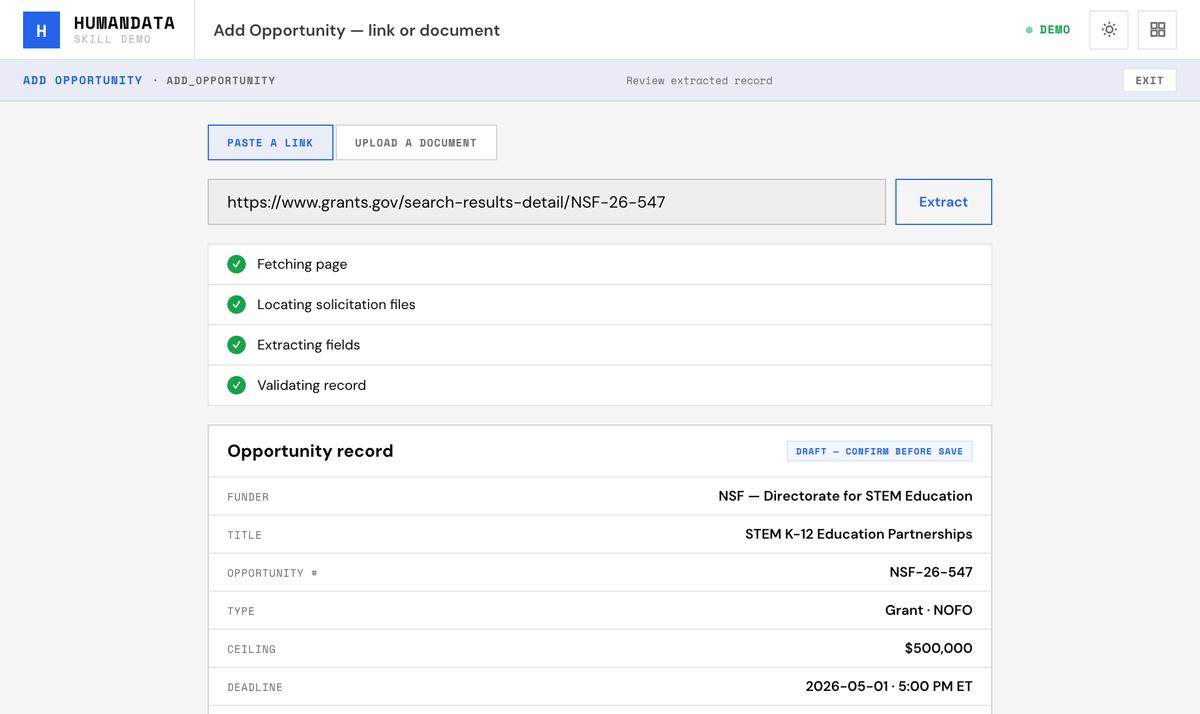
Somebody forwards you a link. Paste it, or drop the solicitation document in, and
it comes back as a structured record: funder, value, deadline, codes, set-aside and
attachments.
Two minutes instead of a browser tab you meant to come back to.
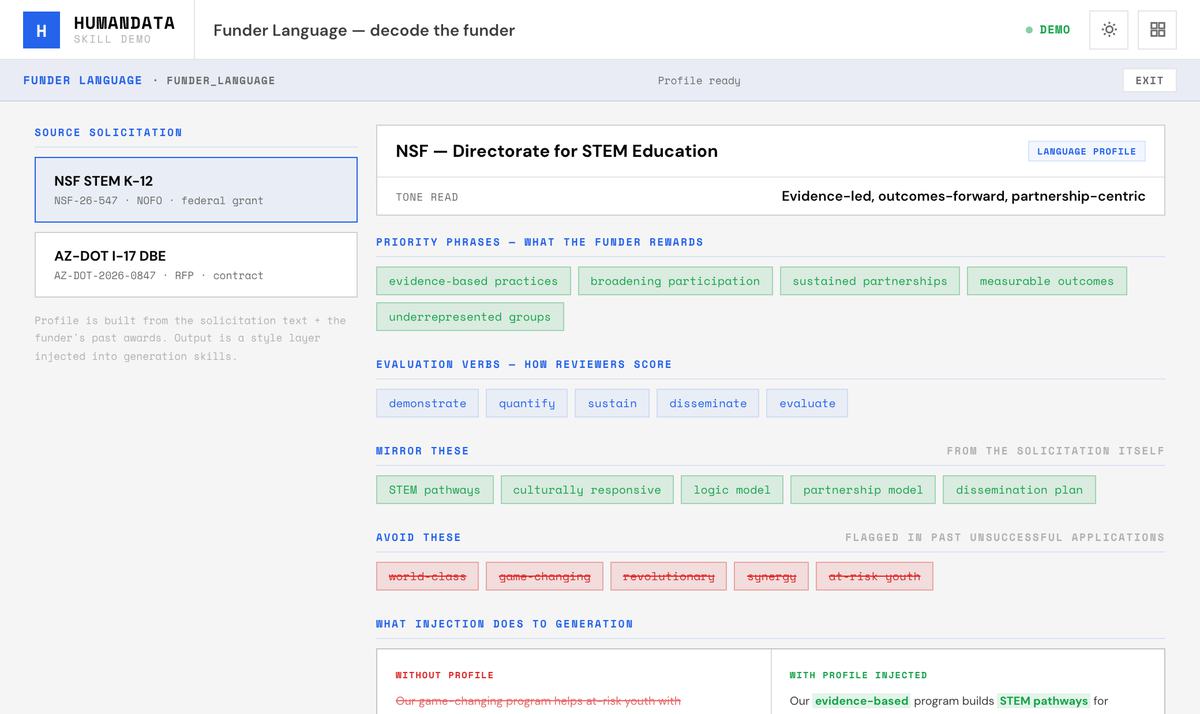
Reads the solicitation and that funder’s past awards for the vocabulary they
reward: the priority phrases, the evaluation verbs, the terms to mirror and the
terms to avoid.
It is applied as a style layer over the writing, which is how a draft stops reading
like a template and starts reading like it was written for that program.
A great many opportunities are out of reach alone and straightforward with a
partner — because of size, past performance, or a set-aside you do not hold. This
finds the organisations worth teaming with.
06
Partner Outreach
And then approaches them, which is the part people put off. Teaming conversations
have to start weeks before a deadline, not in the final week.
What a match looks like when it landsExamples
NOFOCloses in 14 days
Community Development Block Grant — Public Facilities
$250,000 – $1.2MCDBGSB set-aside
Matched on your NAICS code and the certification you confirmed at intake. Eligibility checked before it was shown to you.
RFPCloses in 31 days
Workforce Services — Regional Delivery Partner
$1.8M over 3 yearsRFPOpen competition
Past performance in your profile covers two of the three required references.
03 · Response
The structure is agreed before a word is generated.
The failure mode of every AI writing tool is a confident draft in the wrong shape.
The response path puts two gates in front of that: a decision about whether to bid at
all, and a section schema you confirm before anything is written.
A recommendation with a confidence level, the factors that qualify you, and the
factors that put you at risk. It reads your profile, the opportunity and your
certifications.
A NO-GO is as useful as a GO, and considerably cheaper. It names what
would have to change, which is often a single registration.
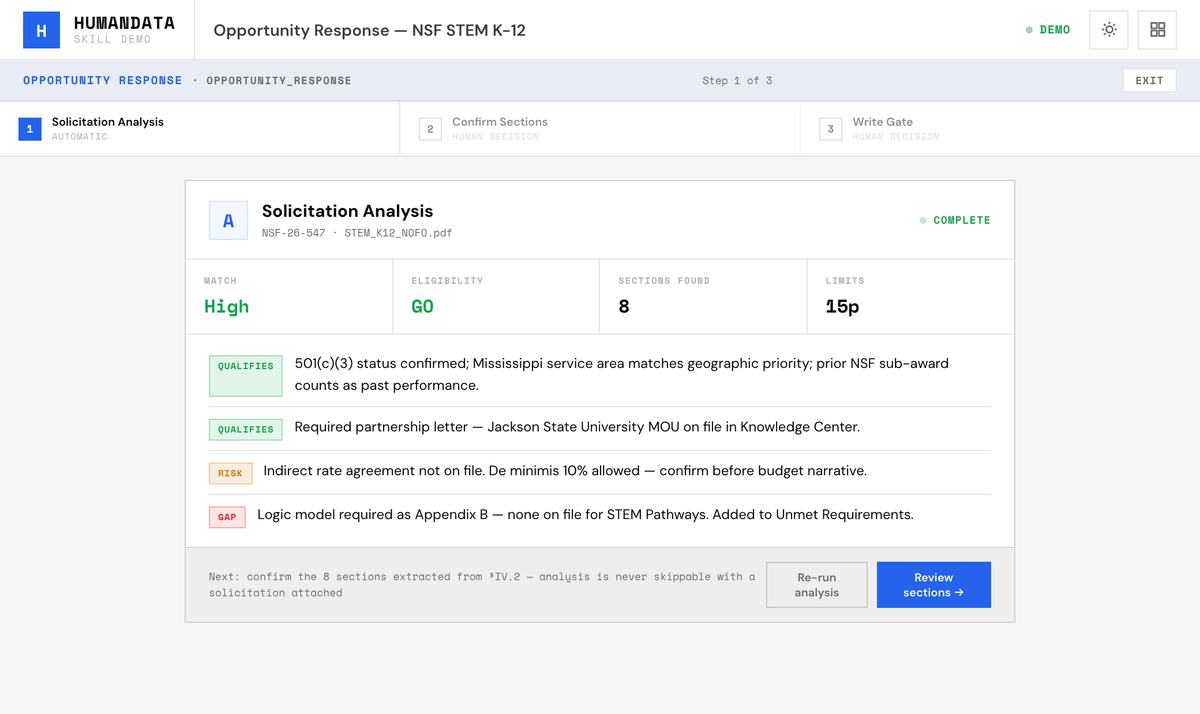
The starting point on any opportunity. It analyses the solicitation, derives the
sections the funder is actually asking for, and shows you that schema to confirm
before generation begins.
Then it hands off to the writing agent in the right mode — grant or
contract — because those are different documents with different rules, not one
document with different words.
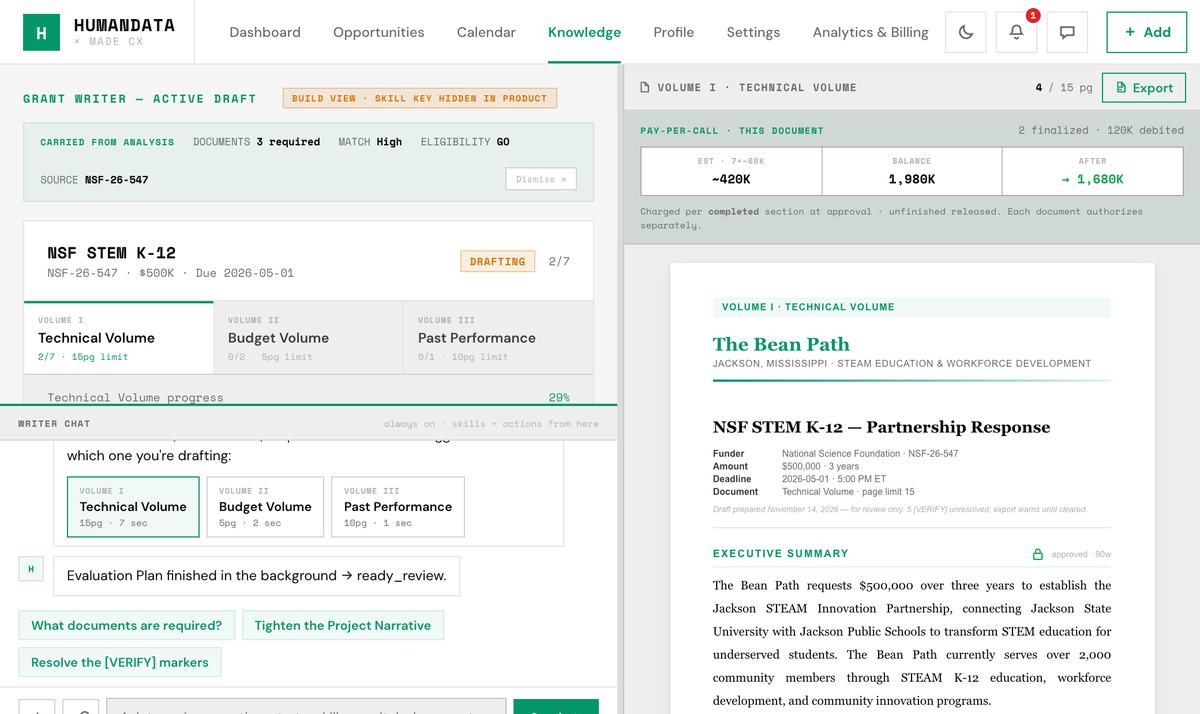
Not a prompt box that returns a document. An agent working a structure it agreed
with you: it takes one section at a time, writes against the solicitation and your
knowledge base, and stops. On each section you Approve, Revise, Edit or
Skip, and a weak paragraph costs you that paragraph rather than the whole
draft.
Anything it could not verify stays marked in the text for a human to
resolve. It does not smooth over a gap to make the prose read better, which is the
behaviour that gets people into trouble with a funder.
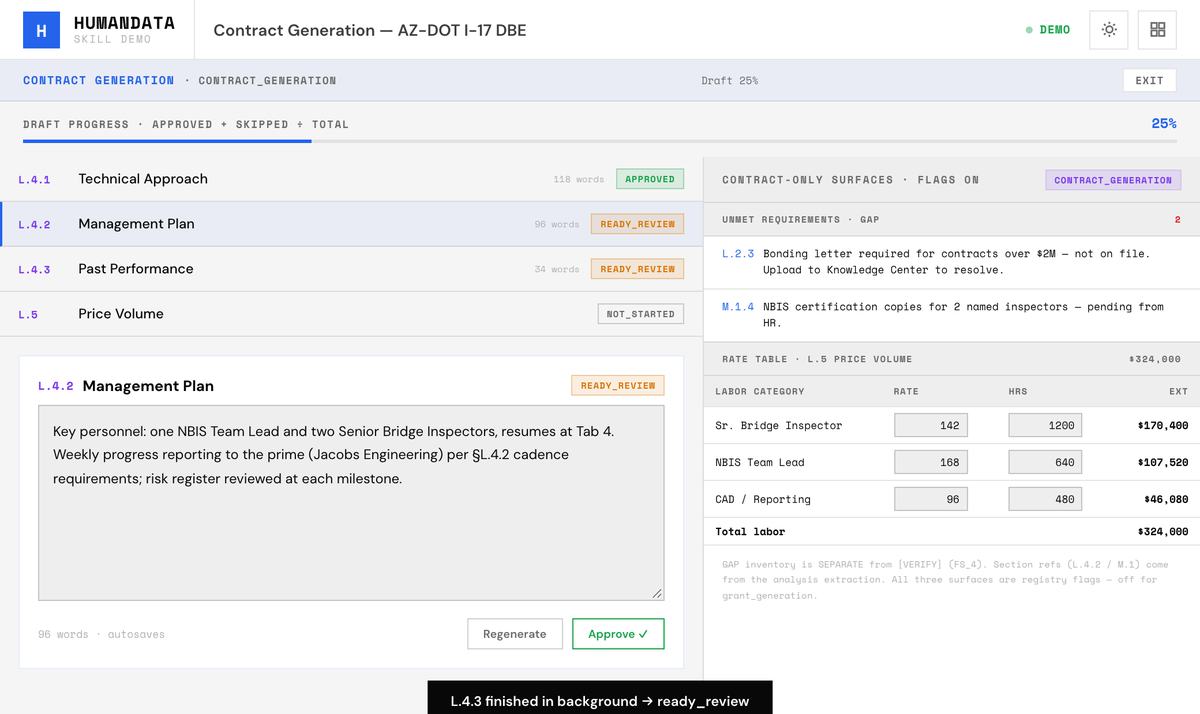
In contract mode the same agent speaks contract: section-number references
against L and M, an inventory of requirements you do not yet meet, and the rate
table.
The draft, section by section
A draft is a list of sections with a state on each one, not a wall of text. Word
counts per section, against the page limit the solicitation sets. Approved
sections lock, so a later run cannot quietly rewrite something you already signed
off.
The agent stays open beside the draft rather than being something you invoke and
dismiss: ask it to revise a section, start another skill, or challenge what it
wrote, without leaving the document.
What comes out
A document with version history, a preview, sharing, and export — including
straight to Google Docs, because the last mile of every proposal is somebody else
wanting it in their own tool.
Drafts can be promoted when they are ready, so there is a difference between
something you are working on and something you would send.
A draft, and the state of every section in itExample
Approved
Executive summary
Signed off. Locked unless you reopen it.
In review
Statement of need
Scored 82 against the funder’s own rubric.
Drafted
Project design
Waiting on you. Nothing is submitted from here.
Drafted
Outcomes and evaluation
Pulled the three numbers you gave us at intake.
Not started
Budget narrative
Needs the figures that are still open on your checklist.
Nothing leaves this screen on its own. A section is yours to accept,
send back, or rewrite, and the price of generating one is quoted before it runs.
A score with no stated basis is worse than no score. It feels like
information.
Document Rating scores any document — a draft, a capability statement, a
narrative — against a named rubric: the funder’s own evaluation criteria, your
internal QA standard, or one you supply.
If there is no rubric on file it asks you for one before scoring. It will
not invent criteria and hand you a number.
Fig. 4 — A rating, and what every point rests onIllustrative
Document
Statement of need, in review
Rubric
The funder’s evaluation criteria, as published in the solicitation
Criterion, and the basis for the scoreWeight and scorePoints
Need is shown with dataThree local figures, each with its source. One is from 2019.
27 / 30
Fit with the funder’s prioritiesTwo of the three stated priorities are addressed by name. Workforce is not mentioned.
21 / 25
Who is served, and whereService area given by census tract. Eligibility is stated once, in the fourth paragraph.
18 / 20
The gap in existing servicesAsserted, not shown. No other provider is named.
10 / 15
Clarity and length412 words over the page limit.
6 / 10
Total82 / 100
Not scored
Cover letterNo rubric on file for this document. It asked for one, and scored nothing.
An example, not a client’s document. The criteria and
weights stand in for a funder’s own.
What it costs to run
Bring your own key, and build on your own dime.
The AI in this product is Claude. You can run it on our account, or you can put in
your own Anthropic API key and pay Anthropic directly.
Your key
In Settings, add an Anthropic API key from console.anthropic.com. It
is stored encrypted for your organisation, and you can remove it at any time.
Model usage then goes on your Anthropic bill rather than through us. What we charge
is separate and visible, instead of being folded into a number you cannot break
down.
You also choose the model used for proposals and generation, rather than being
handed whatever we picked.
Priced per section, quoted first
Pay per call
You are charged for a section when that section is written, and you see the cost,
your balance, and what is left before you agree to it. Ask for a section again and
it is priced again in front of you.
Every document is agreed to on its own. Nothing runs up a bill in the background,
and there is no monthly surprise from work you did not watch happen.
Why we offer it
Because the alternative is a per-seat price with our margin hidden inside your
model usage, and you having no way to tell the two apart.
With your own key the cost of the AI is a line on your Anthropic bill that you can
read, and what you pay us is for the product and the work — which is the thing you
should be judging us on.
If you would rather not hold a key, the organisation account works exactly the same
way and tops up with funds.
One system
The report is not a deliverable. It is the state of your pipeline.
Most funding consultants hand you a PDF and leave. Ours is a live document at
a permanent link that says which version you are reading and what changed since the
last one — because the programs move, deadlines close, and a report that was right in
March is wrong by June.
And the profile behind that report is the profile everything else writes from. The
research becomes your opportunity records, the eligibility call reads the
certifications you confirmed at the start, and the outcomes you gave us turn into the
evidence inside a narrative. Nothing is gathered twice, and nothing is handed over
a wall.
If you would rather read the engineering than the pitch, the
skills architecture is published — every
capability on this page as an entry with its inputs, where it is entered from, and
what it hands on.